
For your Local Experts call us on 0808 301 8231 or Contact Us
Condensation in Lofts
If you have noticed water droplets forming on surfaces in your lofts you could have a condensation problem.
Condensation is becoming a more common problem in homes across Scotland as efforts are taken to improve the thermal efficiency of properties by reducing draughts. If a property suffers from a lack of natural ventilation, it can lead to moisture inside becoming trapped, and condensing on cold surfaces, like those found in lofts.
Moisture will naturally rise up through a property, and if there is access, will enter the loft space via gaps in the ceiling, through the loft hatch or by uncovered downlighters.
If left, condensation in the loft will lead to the deterioration of stored goods, and can cause problems such as black mould growth and even fungal decay and woodworm.
Lofts across Scotland are designed with ventilation at eaves, ridge or through breathable felt, but sometimes these can become blocked. This traps the moisture inside the loft, causing it to condense on the cold surfaces, such as roof timbers.
If your property has had sprayed foam loft insulation installed, always seek professional advice before taking any corrective actions.
We have put together a guide on how to prevent condensation affecting your loft space, but ultimately if the problem persists, or if you’re unsure of the root cause, you may require a damp and timber survey.
What Causes Condensation and Mould Growth in Lofts?
Condensation and mould growth will form in a loft when warm humid air produced in the property rises upwards and becomes trapped in the loft, where it will condense on surfaces. In order to prevent the problem you must first address how moisture laden air is reaching your loft, and then improve ventilation to allow it to escape.
Sometimes minor DIY fixes can prevent the problem, but at other times more specialist treatments may be required.
Here are some common problems that cause condensation to form in lofts:
Insulation Fitted Incorrectly:
Insulation is a vital part of a property’s ability to retain warmth and to reduce energy bills, but if incorrectly installed it can lead to condensation issues. Incorrectly installed spray foam insulation can also cause problems if ventilation is not considered.
If insulation is piled up or laid too deep, it can block soffit ventilation or gable air bricks and this will prevent excess moisture from escaping. To prevent condensation forming, check that the insulation isn’t blocking ventilation.
A Lack of Ventilation:
Lofts are designed as either cold (ventilated) or warm (unventilated) spaces. Old properties were always designed with cold ventilated lofts using natural ventilation, in order to provide air circulation. If trapped moisture cannot escape it will remain in your loft, condensing on cool surfaces.
Unless designed as a warm space, make sure that your loft has soffit/ridge ventilation or gable air bricks, if these are missing, this could help solve the problem.
Poor Air Circulation:
Sometimes there are enough ventilation outlets, but they have been blocked with stored goods and furnishings. Make sure storage boxes and other items are stored away from vents so they do not obstruct airflow. Similar issues occur if a 'barricade' of stored items are placed across a loft and stop direct air flow. Loft boarding above the insulation in the centre of the loft may be useful to create new storage space with adequate air flow.
Water Tanks in the Loft:
Some homes in Scotland will have a water tank in the loft, so make sure this has a lid which will prevent moisture from evaporating and birds or rodents entering. Even cold water tanks will cause a condensation issue if water can freely evaporate.
Excess Moisture inside the Property:
When warm humid air is created in a property it will naturally rise, and if there is no barrier preventing it from entering, it will flow into the loft. Plasterboard does not stop the slow migration of moisture into a loft, unless it is sealed or painted with gloss paint.
Moisture is created by cooking, cleaning and showering, and can enter through open loft hatches, uncovered downlights or cracked or damaged ceilings. Sometimes condensation can become trapped under the insulation if a plastic sheet is covering it, so thorough investigation is key.
How to Stop Condensation Forming in the Loft
Condensation in the loft is often caused by a problem with excess moisture created inside the property, so there are several steps you can take to prevent condensation.
Increase the ventilation inside the loft space by ensuring there are enough vents or air bricks. Air circulation will stop stale air from condensing while improvements to ventilation will help humid air escape.
If there is adequate ventilation, make sure it is not blocked by insulation when it has been fitted, and move stored goods so they are not blocking air flow.
To prevent moisture from inside your property rising up into your attic you may need to deal with the excess moisture inside the whole house. Remove the ability for moisture to enter the roof space by closing loft hatches, insulating the back of them and putting covers on downlights.
Ventilation provided by extractor fans in bathrooms and kitchens will help remove moisture at source, while steps such as drying clothes outdoors, using lids on pans while cooking, and keeping trickle vents open will also help.
Getting Rid of Any Mould in Lofts
Mould will form on surfaces, stored items and timbers if the condensation problem persists. This makes it essential to deal with the moisture entering your loft. Improve ventilation and make sure there is sufficient air circulation. The mould can then be manually wiped away with a mix of bleach and water.
If the problem persists you may require a damp and timber survey to fully understand the internal environment inside your property, this will provide you with advice and recommendations from a local and qualified surveyor.
Preventing Mould and Condensation on Loft Hatches
Loft hatches are often left uninsulated which can create a cold spot that can become mouldy. This is because loft hatches are often one of the coldest surfaces in a property, so warm air will condense on it as it cools on the way through.
To prevent this you will need to stop the surface of the loft hatch from becoming cold, and this is done by improving insulation or fitting a pre-insulated hatch. A layer of insulation such as fibre roll, foam boards or wool insulation can be used.
Preventing Mould and Condensation on Ceilings
Often mould and condensation can form on ceilings where the insulation in the loft above has not been relayed correctly. A gap in the insulation can lead to cold spots where the insulation is missing, allowing warm moist air to condense on this cold surface. These mould patches will often have straight edges corresponding to the missing insulation in the loft.
Simply relay the insulation correctly to prevent this problem. In some ceilings it may not be possible to install insulation such as in sloping eaves, so other forms of anti-condensation treatments may be required. Wise Property Care can provide advice and solutions.
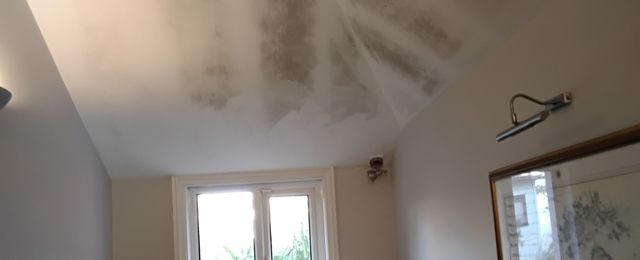
Ghosting - Dark Marks on Ceilings
If insulation is missing from a ceiling, but there is not a constant issue with moisture production in the property, mould will not form on the cold bridge. However, over time you may notice dust attaching to the slightly damp surface of the ceiling. This may be in 'blobs', consistent patterns or straight edges. This dust shadow will be an image of the issue in the loft and is often known as ‘ghosting.’
Condensation in Loft FAQs
-
Is it normal to have condensation in the loft in winter?
While condensation is far more common in Scotland during the winter months, a condensation problem in the loft indicates a more serious issue. If left it could lead to mould growth which can damage stored goods, or even encourage fungal decay or woodworm.
An imbalance of temperatures between the warm humid air inside the property and the cold surfaces in the attic makes condensation more likely, but lofts should have adequate ventilation to allow for any trapped moisture to escape, stopping it from condensing.
If you are suffering with condensation in your loft, specialist help may be required to provide answers and long term solutions.
-
Will Condensation in the Attic lead to further problems?
If left untreated, a condensation problem in the attic can lead to further issues, and more costly repairs in the future. If there is a condensation problem you may notice mould growth, which can form on roof timbers, stored goods or furnishings located in the loft. This can cause them to deteriorate while leaving a musty smell.
When the moisture content of timber is increased, it can cause problems such as wet rot and dry rot. These are more serious problems that can lead to timber losing its structural integrity. Woodworm favour damp timber, so it is not uncommon for a woodworm problem to occur when a condensation problem is sustained in a loft space.
Why Choose Wise Property Care?
When you’re worried about damp, mould and condensation in your home, you want to use a company with experienced and specialist surveyors - with the right training and knowledge to reach the proper diagnosis.
Wise Property Care have both CSRT (Certificated Surveyor in Remedial Treatments) and CSTDB (Certificated Surveyor of Timber and Dampness in Buildings) qualified surveyors operating from a network of local branches - meaning no matter where you are in Scotland, we have a surveyor local to you.
Wise Property Care have been fixing condensation and mould problems and building value back into Scottish properties since 1996.
We have a proven track record working with homeowners, social housing and commercial clients across Scotland, delivering effective preservation solutions while ensuring full compliance with industry regulations and health and safety standards.
We are proud members of the Property Care Association (PCA), the trade association that governs our industry. This means you can trust you’re getting professional and honest advice, and treatments following the industry best practice.
Wise Property Care is endorsed by Which? Trusted Trader - meaning our customer service and workmanship has passed rigorous trading standards assessments.