Your internal environment is a delicate balance, otherwise you may lead to problems with poor air circulation.

For your Local Experts call us on 0808 301 8231 or Contact Us
Black Mould Removal Specialists - Scotland
Wise Property Care have been building back value into properties across Scotland for decades through expert advice and solutions for mould and condensation problems.
Our local surveyors will take time to understand the root cause of the black mould problem affecting your property, and provide recommendations to stop the problem returning - through a specialist damp and timber survey.
We are registered members of the Property Care Association (PCA) and our surveyors hold industry recognised qualifications highlighting our expertise and professionalism, and we have vast experience working closely with social housing providers and local authorities removing mould and solving damp related issues.
Whether you are a homeowner, a commercial property or manage on-going social housing maintenance, we can provide the expertise to help.


What is Black Mould?

Black mould is a common name for different species of fungi that grow in moisture laden environments, appearing as a dark patch on surfaces such as walls, ceilings and behind furniture. It can particularly occur in solid wall properties as the cold outside can easily transmit through to the warmer inside, as there is no cavity to break the transmission.
Black mould is caused by spores which are all around us in the environment. When a spore lands on a suitable damp surface it germinates just like a seed. Mycelium (roots) spread out and feed on the surface, as this colony matures new spores are released and the cycle continues.
It's a clear sign of excessive moisture in a property and will affect the coldest areas of a property, such as uninsulated ceilings or north-facing external walls. If left untreated you may notice large blackish-green stains and a musty odour and this can trigger allergies and health issues such as asthma symptoms. Not all mould is black, it can sometimes be green, white, yellow, brown or grey. In order to fully solve a mould problem it is important to address the underlying moisture problem through ventilation improvements.
What Causes Black Mould in Homes in Scotland?
Black mould is a very common problem that affects thousands of homes across Scotland, and is usually caused by a mix of poor ventilation and cold spots. This means that the moisture created from activities such as cooking, cleaning and washing is unable to escape the property, leading to this excess moisture condensing and forming on cold surfaces. Problems such as leaks or penetrating damp can also cause a mould problem as they create a cold surface on which mould can form.
Because condensation and black mould can be caused by a combination of factors, arranging a mould and condensation survey with Wise Property Care will mean a qualified professional will fully investigate the cause of black mould, and offer recommendations to improve the internal environment of the property.
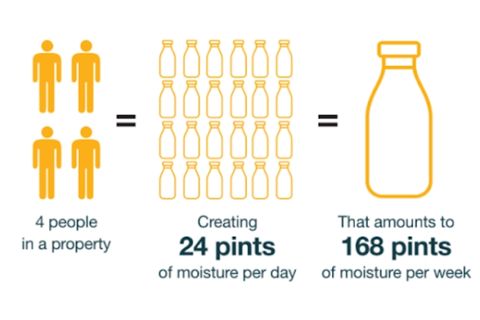
According to BS 5250:2002 an average ‘wet’ household will produce approximately 14 litres (24 pints) of water per day, adding up to well over 98 litres or 21 gallons per week. Dogs will also contribute to moisture vapour production as they can only control their temperature by panting.
Effects of Black Mould on Health
Exposure to black mould spores over a long period of time can cause issues for a person who is immunosuppressed, very young or elderly, or who has a specific allergy. This does not mean that all people who come into contact with black mould will develop health issues, but it can cause some to suffer health effects such as coughing, wheezing or sore throats.
Moist stale air which is closely associated with damp, condensation and mould problems may contain mould spores, dust mite allergens and volatile organic compounds (from cleaning products, hair spray, deodorant and scented candles), which can also contribute to asthma symptoms.
If you think the black mould problem is exacerbating your health problems, you should seek professional help to remove the problem, and speak to your GP or seek professional medical help.
How to Remove Black Mould?
Isolated areas of black mould can sometimes be resolved by cleaning with household products widely available at supermarkets, especially around window frames or bathroom sinks. You should consider improving ventilation in these areas.
If however the problem is widespread and you have recurring mould outbreaks you may require professional mould cleaning services, and a condensation survey to fully understand the internal environment in your home and why there is a mould problem in the first place.
You may be able to clean small areas affected by black mould but it is important to make sure that you improve ventilation through opening windows or trickle vents to prevent the problem reoccuring.
Professional Mould Cleaning
If you’re concerned about a mould problem in your property, and you’ve noticed it get worse over time, Wise Property Care can carry out a survey to fully understand the problem, and offer insights around improving ventilation, typically through Positive Input Ventilation (PIV) units or installing extractor fans. We will also investigate the thermal properties of the building, and offer recommendations where required to make improvements either through thermal plastering or insulation.
Our trained and experienced technicians will then conduct a specialist cleaning process using professional fungicidal treatments to remove the mould at source. We will then carry out improvements to prevent the problem returning, if you wish to go ahead.
Whether we’re working with a domestic property, a commercial project or carrying out on-going maintenance for social housing providers, we will make sure to take care of the property and ensure the mould problem will not return.
Professional mould cleaning services may be required for extreme cases of mould growth in properties across Scotland.
How to prevent Black Mould?
Black mould is caused by excess moisture inside a property, so it is essential to control the moisture being produced and provide ventilation for its removal, especially in areas such as kitchens, bathrooms and utility rooms.
There are several ways to reduce the amount of moisture in your home - through increased ventilation, keeping the heat in your property and removing the excess moisture.
In order to keep an ideal internal environment, you need a balance between insulation to keep heat inside your property and prevent cold spots, ventilation to help remove excess moisture, and heating to keep your property at a comfortable temperature. If the balance is out of balance, you may have a condensation problem that leads to black mould.
Here are some handy tips to produce less moisture in your home:
-
Cooking: - To prevent less moisture in your home, when you are cooking try to reduce the amount of moisture by placing lids on pans and do not leave pans of water on the hob when not in use. Always use the kitchen extractor hood, extractor fan or open a window when cooking.
-
Bathing: - When bathing, run the cold water first then add the hot, as this will reduce the amount of steam produced, which will reduce condensation on surfaces.
-
Washing Clothes: - If possible put any washing outdoors to dry if you can. If this isn’t possible, place in the bathroom or kitchen with the door closed and the window open or extractor fan on. If you have a tumble dryer make sure the vent leads outside. Try not to dry clothes on radiators as the moisture will stay in the room, and condense on other surfaces.
-
Wiping down wet surfaces: - When wiping down surfaces to remove condensation, wring out the cloth in the sink and do not leave the wet cloth to dry on a radiator, as the moisture will be released again.
-
Close Doors: - Close kitchen and bathroom doors when these rooms are in use even if the kitchen or bathroom has an extractor fan as this will help remove the moisture through the ventilation fans. If left open the moisture could move into other rooms, especially bedrooms which are often colder and more likely to be affected by condensation.
-
Trickle Vents: - Keep trickle vents and light vents open. If you have air bricks or vents keep these clean and make sure they are not covered over or blocked by large furniture.
-
Cupboards and Wardrobes: - Ventilate cupboards and wardrobes by leaving doors ajar, so air can circulate. To reduce the risk of mildew on clothes and other stored items, allow air to circulate round them by removing false wardrobe backs or drilling breather holes in them at the top and bottom. Avoid putting too many things in them as that will stop air from circulating.This is a particular problem with built in wall cupboards as the masonry is often a cold condensing surface.
If problems persist you may require a professional survey, which can be used to understand the source of the moisture production, where improvements can be made to ventilation, and if cold spots are apparent, so may require thermal insulation improvements.
Mould Surveys Scotland
If you want an answer for the mould problem in your property, no matter where you are in Scotland, Wise Property Care can help. A qualified surveyor local to you will attend your property and carry out a damp survey to fully examine and understand the cause behind the mould problem, and provide you with a detailed report outlining their findings.
Our surveyors are typically CSRT or CSTDB qualified through the Property Care Association (PCA) meaning they can use their expertise and knowledge to fully understand a dampness problem in a property.
The surveyor will then carry out an inspection of the exterior and interior of your premises looking for a range of defects relating to condensation, damp, timber or structural issues.
They will take time to determine the extent of the black mould and investigate what’s causing it, understanding if the problem is caused by excess moisture production, a water leak, penetrating damp or any other factors.
The surveyor will use a range of tools to calculate internal conditions such as humidity, temperature and dew point.
A thermal imaging camera can also be used during a survey to identify cold spots and cold bridging that might cause condensation to form. The camera detects differences in surface temperature, making it possible to see the pattern of cold and condensation in properties, and what might be causing it.
A thermal imaging reveals a cold spot (15.3c) on an external wall, where moisture can condense.
This inside surface of the cupboard is colder and more prone to condensation, allowing black mould to grow.
The surveyor will then provide you with a thorough survey report with their findings from the survey on the property. This will be backed with thermal imaging photographs taken on site, any readings taken, and evidence of any other issues found.
They will provide you with a full description of any professional mould cleans required, and recommendations around improving ventilation, thermal plastering, anti condensation paints or insulation top ups if required. This will be detailed in the report, along with the costs involved, should you wish to go ahead.
When you are having a survey carried out on your property it’s essential you choose a company with experienced and specialist surveyors, and that have the right training and knowledge to reach the proper diagnosis and recommendations for work in Scottish properties.
Specialist Mould Removal Services
Because every property in Scotland is different, the specialist mould removal service will be tailored to your specific needs through a thorough survey from a qualified surveyor. Our team will follow a proven process to ensure long term safe and effective results.
They will identify any affected areas and any hidden problem spots and prepare the area for treatment by isolating the work zone and protecting your belongings if necessary.
Wearing the appropriate safety equipment, Wise Property Care technicians will then conduct the mould cleaning process by using professional-grade fungicidal solutions to kill the mould.
They will take time to thoroughly clean or remove any contaminated materials, ensuring that even hard-to-reach or hidden mould colonies are dealt with.
If you have chosen to go ahead with any ventilation or thermal improvements, the technicians will then carry these out.
Before leaving the site we will double-check that the mould has been successfully eradicated and that your property is dry, clean and safe.
Whether it’s a domestic home or housing stock undergoing regeneration for a housing association or local council, Wise Property Care maintains the highest quality standards for all stakeholders involved.
Why Choose Wise Property Care for Mould Removal?
Wise Property Care have both CSRT (Certificated Surveyor in Remedial Treatments) and CSTDB (Certificated Surveyor of Timber and Dampness in Buildings) qualified surveyors operating from a network of local branches - meaning no matter where you are in Scotland, we have a surveyor local to you.
Wise Property Care have been fixing condensation and mould problems and building value back into Scottish properties for over 20 years.
We have a proven track record working with social housing and commercial clients across Scotland, delivering effective preservation solutions while ensuring full compliance with industry regulations and health and safety standards.
We are proud members of the Property Care Association (PCA), the trade association that governs our industry. This means you can trust you’re getting professional and honest advice, and treatments following the industry best practice.
Wise Property Care are endorsed by Which? Trusted Trader - meaning our customer service and workmanship has passed rigorous trading standards assessments.
We are also members of Trustmark and are CHAS, Constructionline and Alcumus (SafeContractor) approved.
We are rated ‘Excellent’ on Trustpilot with over 550 independent customer reviews from across our branches in Scotland.
We cover the whole of Scotland from our network of local branches:
Mould FAQs
-
Can you live with black mould in your house?
No, you should not live in properties with a severe black mould problem, according to government guidance as it poses health risks such as respiratory illnesses, infections, allergies or asthma. Symptoms of a mould problem may also lead to coughing, wheezing and breathlessness, so it is important to deal with a mould problem at source. Condensation is the leading cause of mould, so excess moisture needs to be controlled, and you may require specialist cleaning for the mould.
-
What is black mould caused by?
Black mould is caused by an excess of moisture within an internal space, typically caused by condensation, leaks or flood damage. In Scotland condensation is the most common cause of damp, and therefore likely to be behind a black mould outbreak - although a professional surveyor will be able to investigate fully.
-
How dangerous is black mould to health?
In Scotland black mould can trigger allergic reactions in immune systems of those who are
immunosuppressed, very young or elderly, or who has a specific allergy. It may also cause some to suffer various symptoms including coughing, wheezing, sore throats and itchy eyes. -
How do you remove mould from painted walls?
To remove isolated patches of black mould from your property you can use household products, but make sure to wear gloves and eye protection. To prevent the problem from returning you must address the cause of the black mould, usually caused by condensation. For more serious outbreaks you may require professional mould cleaning specialists.