
For your Local Experts call us on 0808 301 8231 or Book A Survey Online
Dry Rot Treatment Scotland
Dry rot (Serpula lacrymans) is a destructive form of fungal decay that can cause extensive structural damage to timber - a common material used in buildings in Scotland. It digests wood through its mycelium, causing it to lose structural integrity, and is much more destructive compared to wet rot. If you suspect a dry rot problem in your property you should arrange for a professional damp and timber survey to be carried out to understand the full extent of the damage.
Wise Property Care are experts in dry rot identification, treatment and property preservation. We are Property Care Association Members and have branches across Scotland, so we are able to assist you with any issues you may have relating to damp and timber.
We have put together a guide on how to identify dry rot, how it occurs and what to do if you suspect a dry rot problem in your property.


What is Dry Rot?
Dry rot is a type of fungal decay that attacks and consumes timber, which causes it to lose its strength. It is capable of spreading in areas without any source of moisture, using strands to transport moisture meaning it can spread rapidly.
This makes it very important to identify and treat as soon as possible. If left untreated it can consume large amounts of timber, and spread throughout a property. It thrives in damp, dark and poorly ventilated areas and is a common property preservation issue in Scotland.
What is the Difference between Dry Rot and Wet Rot?
Dry rot is capable of spreading through masonry and low-moisture timber from 20%, but optimum 30-40%, whereas wet rot requires high timber moisture levels of 40-60%. Wet rot growth is isolated at the source of moisture and does not spread through masonry, but some species can grow across masonry. They require different treatment processes so correct identification is key.
Can dry rot spread through walls?
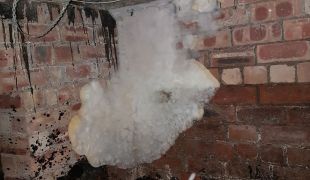
Yes, dry rot can spread through walls, and this is why it is so much more destructive than wet rot. Dry rot can grow strands that can conduct nutrients through brickwork, plaster and concrete, and can even spread over steelwork. Because of this dry rot causes serious damage to many properties in Scotland, especially older and historic properties with extensive decorative and structural timber.
What Causes Dry Rot in Scotland?
Dry rot is a common and serious problem that affects Scottish properties due to the damp and humid weather conditions, especially in coastal areas that suffer from wind driven rain. There are many properties affected in Scotland due to the building materials used.
Common causes of dry rot in Scotland:
- Leaks from roof defects and damaged sarking or roof coverings
- Plumbing leaks or blocked drains
- Blocked or damaged gutters
- Rising damp affecting ground floor timbers, such as joists
- Penetrating damp through walls or around windows
- Spalled masonry, missing mortar or defective external renders
- Poor ventilation, particularly in solums
- Condensation build-up
Dry rot spores are all around us in the atmosphere, but will only germinate in the right conditions:
What is the Dry Rot Lifecycle?
Dry rot is a living, growing fungus which feeds off and destroys wood to survive. Moisture is needed for it to grow and it can spread quickly given the right conditions. There are four main stages in its life cycle, all which have specific characteristics to look out for in your property.

Spores
Dry rot begins as tiny, invisible to the naked eye spores. However, in large quantities, these dry rot spores appear as a fine orange/brown dust, covering surfaces. Dry rot spores remain harmless unless they land on timber at the correct moisture content and temperature, at which point they germinate.

Hyphae
Where moist timber is present, the spore will begin to grow. The spore produces very fine white strands that allow the dry rot fungus to grow by infiltrating the wood and feeding on it. This is how the dry rot breaks down the structure of the wood, weakening it. If dry rot signs can be spotted at the fine white strands (hyphae) stage, there is a good chance of containing it before it spreads.
Mycelium
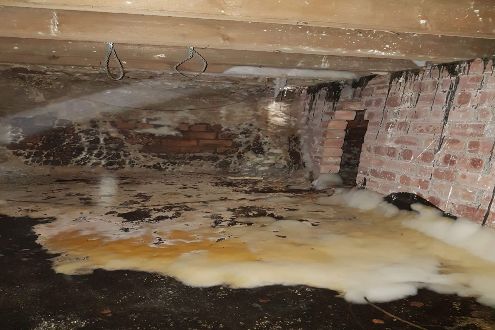
As the hyphae grow they form a large flat mat known as mycelium, which is pale grey with lilac flashes. If the mycelium forms in still air conditions, it will look like cotton wool, with lilac and sulphur yellow flashes. Mycelium will spread away from the original infection in search of new timber to attack.
Fruiting body
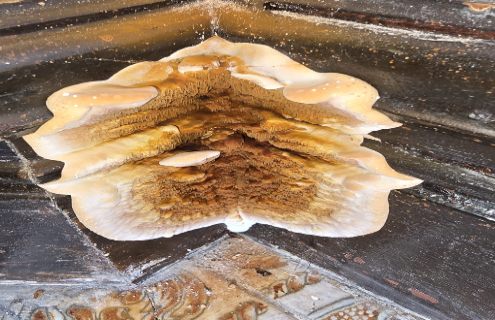
In suitable conditions, dry rot mycelium can spread rapidly, particularly in dark and damp areas with little or no ventilation. When the mycelium is struck by natural or artificial light, this causes sporophores or 'fruiting bodies' to be produced. If conditions for growth become adverse, the mycelium will produce sporophores to ensure survival. The spores are pumped into the atmosphere and land on other susceptible areas in the building where dry rot growth can continue. This process allows the dry rot life cycle to begin again.
How to Identify Dry Rot in Scotland
Spotting dry rot can be difficult as it is often in hard to access areas such as sub floor voids. If however you have spotted the telltale signs of dry rot, you should book a survey with a professional surveyor as soon as possible, they can fully assess the extent of the damage, and prevent the problem from recurring.
Signs to look out for:
- Timber splitting and cracking into small cubes, known as cuboidal cracking
- Wood shrinking, warping or darkening
- Red dust on surfaces
- Evidence of white mycelium spreading over timber
- Rust coloured fruiting bodies
- Mushroom-like smells or damp and musty smells
Dry Rot Survey
If you are worried about a dry rot problem or you think you might have dry rot in your property, it is recommended you get a damp and timber survey from a professional surveyor immediately. They will be able to confirm a dry rot outbreak, the source of moisture causing the problem, and then assess the extent of damaged timber.
All findings will be detailed in a survey report and the surveyor will be able to answer any questions you may have.
Damp and Timber reports are conducted by a professional surveyor who usually has CSTDB or CSRT qualifications, which means they can correctly identify damp and timber problems to strict industry standards.
We can provide damp and timber surveys for domestic homes, commercial projects and for listed or historic properties across Scotland.
Scotland’s Dry Rot Treatment Specialists
Wise Property Care have solved thousands of dry rot outbreaks in properties across Scotland for over 20 years and back our work up with our long term guarantees.
- The first step is to find the source of moisture and fix the associated problem - whether it is a building defect, rising damp, penetrating damp or a lack of ventilation.
- We will then remove all affected timber, often extending beyond the visible signs of damage.
- The next step is to apply a fungicidal treatment to kill the dry rot spores.
- Where necessary we will treat surrounding masonry with fungicide.
- We will then provide you with a long lasting guarantee, as detailed in the survey report
Our trained and experienced technicians will talk you through the full process when they arrive on site, and are equipped with protective floor coverings, extraction units and vacuums in order to keep your property clean and tidy.
Contact our Dry Rot Experts for a Damp and Timber Survey Today
Don't let dry rot compromise the structural integrity of your property. Contact Wise Property Care today to book a damp and timber survey from an experienced and qualified surveyor local to you. Wise Property Care have been building value in Scottish properties for over 20 years.
We are a proud member of the PCA and have a range of CSTDB, CSRT and CSSW qualified surveyors operating out of our local branch network covering Scotland. This means you can trust you’re getting professional and honest advice, and treatments following the industry best practice.
Wise Property Care are endorsed by Which? Trusted Trader - meaning our customer service and workmanship has passed the rigorous trading standards assessments.
We are rated ‘Excellent’ on Trustpilot with over 550 independent customer reviews from across our branches in Scotland.
We cover the whole of Scotland from our network of local branches:
Dry rot FAQs:
-
Which is worse, wet or dry rot?
Generally, dry rot is worse because it is more aggressive, and if the conditions are right can spread quickly through structural timber, masonry and across steelwork. This means over time dry rot can effectively destroy whole sections of timber across a property. Wet rot can cause structural failure in timber if it goes unnoticed, but decay tends to be isolated at the source of the moisture.
-
What does dry rot smell like?
Typically dry rot has a mushroom odour which is often partnered with damp, musty smells. It can vary depending on the type of wood, location and the extent of the problem.
-
Who can diagnose dry rot?
It is best to have a PCA accredited professional surveyor, either with a CSRT (Certificated Surveyor in Remedial Treatment) or CSTDB (Certificated Surveyor of Timber and Dampness in Buildings) qualification. They will be able to accurately diagnose the type of fungal decay and the extent of damage, making sure not to miss anything. They will also identify the source of moisture fuelling the dry rot, and can provide advice around damp proofing if required.
-
How can you tell if you've got dry rot?
Musty smells, discoloured wood, cube-shaped cracks or fungal growth will indicate you have a fungal decay problem. If there is evidence of red dust or pancake-like structures known as fruiting bodies this will give further evidence that the fungal decay is dry rot.